"AI agents" have become seemingly ubiquitous over the past three years: everyone wants an "agent," is building an agent, or already has one. But there's a critical distinction that most of the market glosses over:
An AI agent is a single intelligent actor. An Agentic Workflow is a system that orchestrates multiple agents alongside deterministic steps to accomplish complex, multi-stage business processes end to end.
In this article, we'll dive deep into how IT and tech leaders are architecting AI agents and Agentic Workflows.
TL;DR Comparison
Pure Deterministic Automation | Standalone AI Agent | Agentic Workflow (Hybrid) | |
|---|---|---|---|
Handles ambiguity | ❌ | ✅ | ✅ |
Guarantees precision | ✅ | ❌ | ✅ |
Spans multiple systems | ✅ | Limited | ✅ |
Adapts to new scenarios | ❌ | ✅ | ✅ |
Auditable & compliant | ✅ | ⚠️ Difficult | ✅ |
Human oversight | Manual only | Ad hoc | By design |
Multi-agent coordination | N/A | ❌ Single agent | ✅ |
What is an AI Agent?
An AI agent is a software entity powered by a large language model (LLM) that can:
Interpret intent: Understand what a user or system is asking, even in natural language
Reason about next steps: Decide what actions to take based on context
Use tools: Call APIs, query databases, search knowledge bases, browse the web, or execute code with sandboxes and other advanced features
Maintain memory: Remember prior interactions to inform future decisions
Think of an AI agent as a single, intelligent worker. You customize it by giving it instructions, access to tools, and a knowledge base, and it goes to work. It can answer questions, draft documents, classify tickets, or look up information.
Agents work best when handling one task at a time, within one context, using one set of instructions. For simple, well-scoped problems (Ex. "answer customer questions from this FAQ" or "pull data from this spreadsheet"), that's perfectly fine.
But real enterprise processes aren't simple. Most are multi-step, multi-system, and require different types of intelligence at different stages.
What is an Agentic Workflow?
An Agentic Workflow combines:
Multiple AI agents: Each with their own specialized instructions, tools, and knowledge bases (Likely also includes an orchestrator agent that manages its own teams of sub-agents)
Deterministic steps: Structured database queries, OCR, if-else logic, and API calls
Human-in-the-loop checkpoints: Approval gates where humans review, override, or guide the process at critical junctures
An Agentic Workflow is a system, a carefully designed pipeline wherein cutting-edge AI reasoning and deterministic execution work together in harmony.
Why the Distinction Matters: The Limits of Agents Alone
Here's the uncomfortable truth about standalone AI agents: LLMs are probabilistic, but not every step in a business process is. Large language models are brilliant at reasoning, summarization, classification, and creative generation. But they are inherently probabilistic: they don't guarantee the same output every time, they can hallucinate, they can misinterpret edge cases.
For many steps in a business process, you need determinism:
Querying a database should return exact results, every time
Extracting certain fields from a structured document should be perfect
Validating a compliance check should follow explicit rules
Routing a request to the right department should follow defined criteria
An AI agent alone can't guarantee these things. An Agentic Workflow can, because it uses the right tool for each step.
Real Processes Span Multiple Systems
Enterprise processes don't live in one tool. A KYC check might start with an inbound email, query a CRM, pull data from a government database, run a web search with a sandbox, pipe it through a compliance agent, generate a report, and route it for human approval. No single agent should handle all of that autonomously.
An Agentic Workflow allows you to orchestrate any business process, assigning each step to the right component: a deterministic API call here, a specialized AI agent there, a human approval gate at that critical juncture.
Governance Requires Predictability
In regulated industries (financial services, healthcare, government, defense) you can't deploy a system where an LLM has unconstrained autonomy over a multi-step process. Auditors need to trace the logic of each step; compliance teams need to know which decisions were made by AI and which were validated by rules or humans.
Agentic Workflows provide this level of transparency by design: every step is broken out, visible, traceable, and auditable, because the workflow explicitly defines where AI reasoning is applied and where deterministic logic governs.
Deterministic and Agentic in Harmony
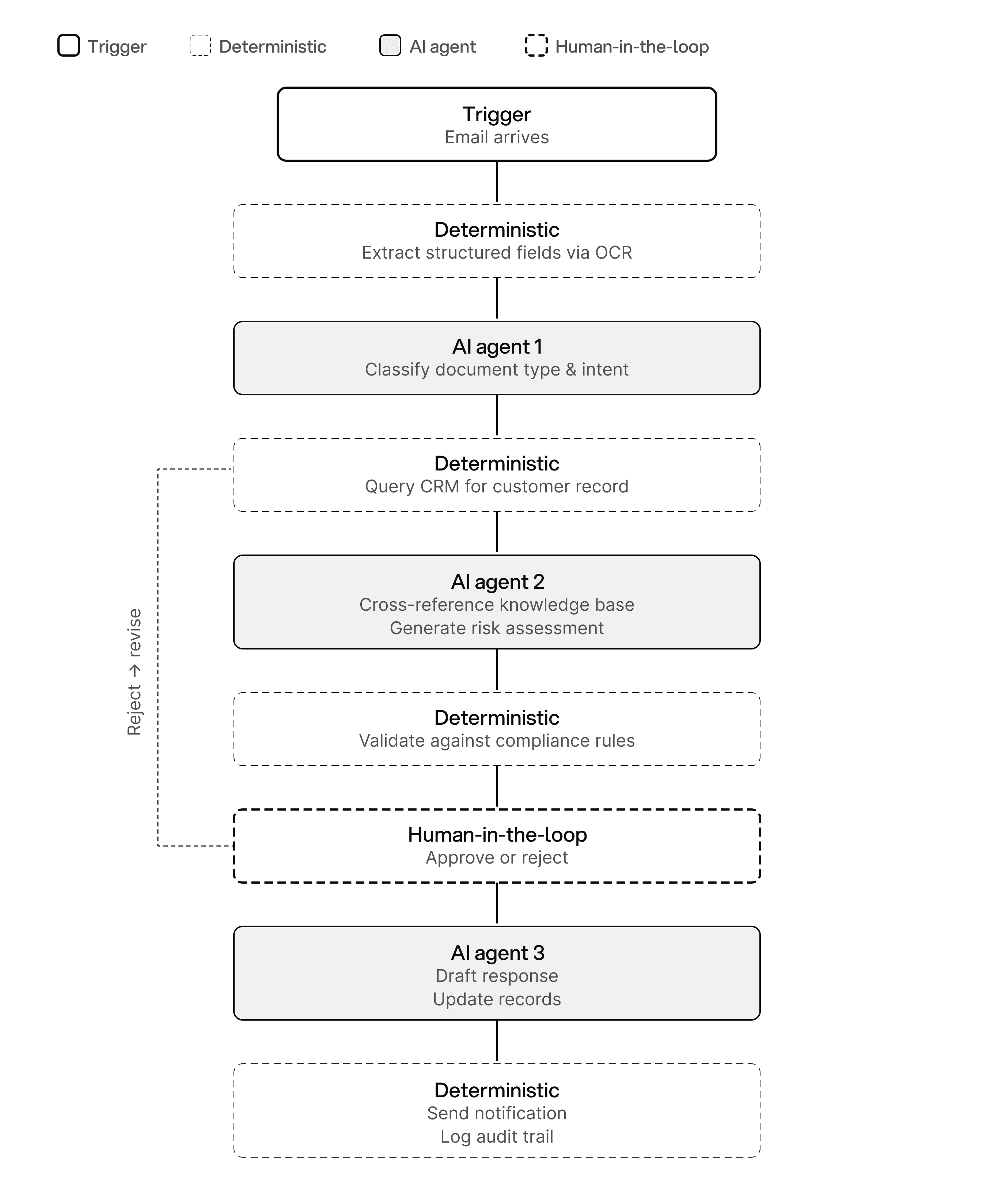
The most powerful enterprise automation architectures are neither fully deterministic nor fully agentic. That's why we're proud to pioneer the Agentic Workflow. Here's just one example of how one workflow might be architected.
Notice what's happening: AI is used where reasoning is needed; deterministic steps are used where precision is required; humans are involved where judgment is critical. Each step of the workflow does what it does best.
The most sophisticated Agentic Workflows go beyond a single AI agent plus deterministic steps. They employ multi-agent orchestration, a pattern where a central orchestrator LLM coordinates multiple specialized sub-agents, each with its own tools, knowledge bases, and instructions.
Why This Matters for CIOs and IT Leaders
If you're evaluating AI platforms for your enterprise, here's the takeaway:
A platform that only gives you AI agents or only step-by-step process automation gives you the building blocks. Useful, but incomplete.
A platform that gives you Agentic Workflows gives you the complete AI-powered automation toolkit to:
Automate complex, multi-step processes that span your entire tech stack
Maintain compliance and auditability at every step
Use AI where it excels (reasoning, classification, generation) and deterministic tools where precision is non-negotiable
Orchestrate multiple specialized agents that collaborate on complex tasks
Keep humans in the loop at the moments that matter most
How StackAI Approaches Agentic Workflows
StackAI is purpose-built for this hybrid paradigm. The platform provides a visual workflow canvas where teams combine:
LLM nodes with configurable prompts, instructions, knowledge bases, and tool calls
Deterministic nodes: Database queries, OCR, If/Else logic, API calls, rule-based validation
AI Routing nodes: Intelligent classification that directs flow dynamically
Human-in-the-Loop nodes: Approval gates that pause execution for human review
Multi-agent orchestration: A central orchestrator coordinating specialized sub-agents that run in parallel or sequence
And because StackAI is built for IT teams and CIOs, it comes with enterprise-grade governance (SOC 2 Type II, HIPAA, GDPR), flexible deployment (SaaS, Dedicated Cloud, Private Cloud, or On-Premise), and white-glove support from AI Strategists and Forward-Deployed Engineers who partner with your team to design, build, and scale production agents.
The Bottom Line
AI agents are impressive. But agents alone aren't enough to automate the complex, regulated, multi-system processes that define how enterprises actually operate.
Agentic Workflows—the marriage of deterministic precision and AI reasoning, orchestrated into multi-step, multi-agent systems—are the architecture that unlocks real enterprise transformation.
StackAI is the enterprise platform for building and orchestrating Agentic Workflows at scale. To learn how our team of AI Strategists and Forward-Deployed Engineers can help you design production-grade workflows for your organization, get a demo.

Karissa Ho
Growth at StackAI